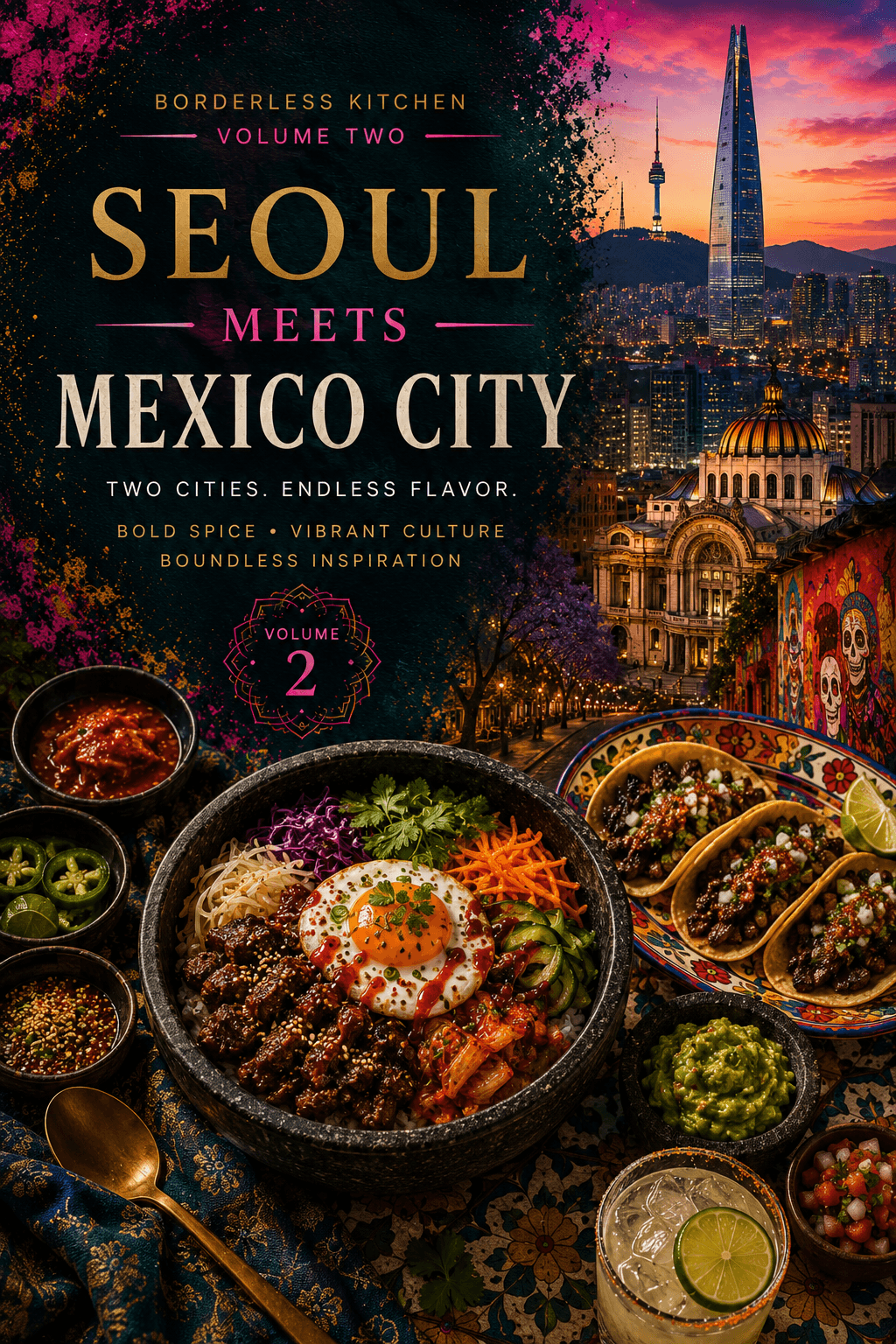
Borderless Kitchen · Seoul × Mexico City
Available nowSeoul Meets Mexico City
The second volume of the Borderless Kitchen series.
2026 · Seoul × Mexico City
Seoul Meets Mexico City is a book about two cities that have built entire culinary cultures around fermentation, heat, and the slow accumulation of flavor.
Kimchi and salsa. Doenjang and mole. Gochugaru and chile de árbol. Two pantries built on the same principle — that time and patience transform a raw ingredient into something with depth that shortcuts cannot replicate.
This volume holds thirty recipes that live at the intersection of those two pantries. Not fusion. Convergence — two traditions arriving at the same truth from opposite directions.
Why Korean and Mexican cooking belong together
The parallel runs deeper than most people expect.
Both cuisines are built on fermented chili pastes that do multiple jobs simultaneously: gochujang provides heat plus umami plus sweetness; guajillo and ancho rehydrated in lard provide heat plus earthiness plus fruit. Both start from chili, both build through fermentation or slow cooking, both end at complexity.
Both cuisines rely on long braises as their most important technique: galbi-jjim (braised short ribs in ganjang and aromatics) and barbacoa (long-braised beef in dried chili, achiote, and citrus) are structurally the same dish. A marinated protein, a long cook in liquid, served with starch and acid.
Both cuisines use acid as the finishing counterpoint that cuts through rich, fatty proteins: kimchi's lactic acid fermentation vs pickled red onion and lime in Mexican cooking. Both are bright, both essential, both applied at the end.
The same substitution logic from Tokyo Meets Tuscany applies here. Gochujang braised short rib tacos are not a novelty — they're the result of recognizing that gochujang and guajillo are functionally identical ingredients.
Preview recipes
Three recipes from Seoul Meets Mexico City are available free on the site — a preview of the book's logic:
Gochujang Pasta — Korean fermented chili paste in an Italian-style pasta sauce. Rigatoni, guanciale, gochujang-butter emulsion, Pecorino.
Kimchi Quesadilla — fermented vegetables in a toasted flour tortilla. The kimchi replaces salsa; the lactic acid fermentation does the same acid-cutting job.
Gochujang Braised Short Rib Taco — the galbi-barbacoa convergence in taco format. Gochujang + guajillo braise, 3 hours, served with warm tortilla and pickled daikon instead of pickled red onion.
What's in the book
Thirty recipes structured around six flavor principles shared by both cuisines:
- Fermented depth (gochujang, doenjang, kimchi, gochugaru / mole, adobo, salsa negra)
- Long braise (galbi-jjim, samgyeopsal / barbacoa, carnitas, birria)
- Lactic acid finish (kimchi, kkakdugi / pickled jalapeño, salsa verde, lime)
- Heat that stacks (chili paste, gochugaru flakes / fresh chili, dried chili, chile oil)
- Rice and tortilla as neutral starch base — both cuisines use a near-neutral starch to absorb surrounding flavor
- Egg as binding and enriching element — the fried egg finishes a bibimbap the way a fried egg finishes chilaquiles
Publication
Seoul Meets Mexico City is out now — paperback and Kindle. Readers on the Borderless Kitchen email list get early access to new volumes and free recipes.
As an Amazon Associate we earn from qualifying purchases. This is an affiliate link — it costs you nothing extra.
Paperback $19.99 · Kindle $9.99
The full recipes live inside the book.
Buy Seoul Meets Mexico City on AmazonAs an Amazon Associate we earn from qualifying purchases. This is an affiliate link — it costs you nothing extra.
Paperback $19.99 · Kindle $9.99
Free download
Both volumes are out now.
Tokyo Meets Tuscany and Seoul Meets Mexico City — Japanese technique against Italian tradition, Korean fermentation against Mexican fire. Start with three recipes, free.